Partner Always on Their Phone? What Phubbing Does and What Helps
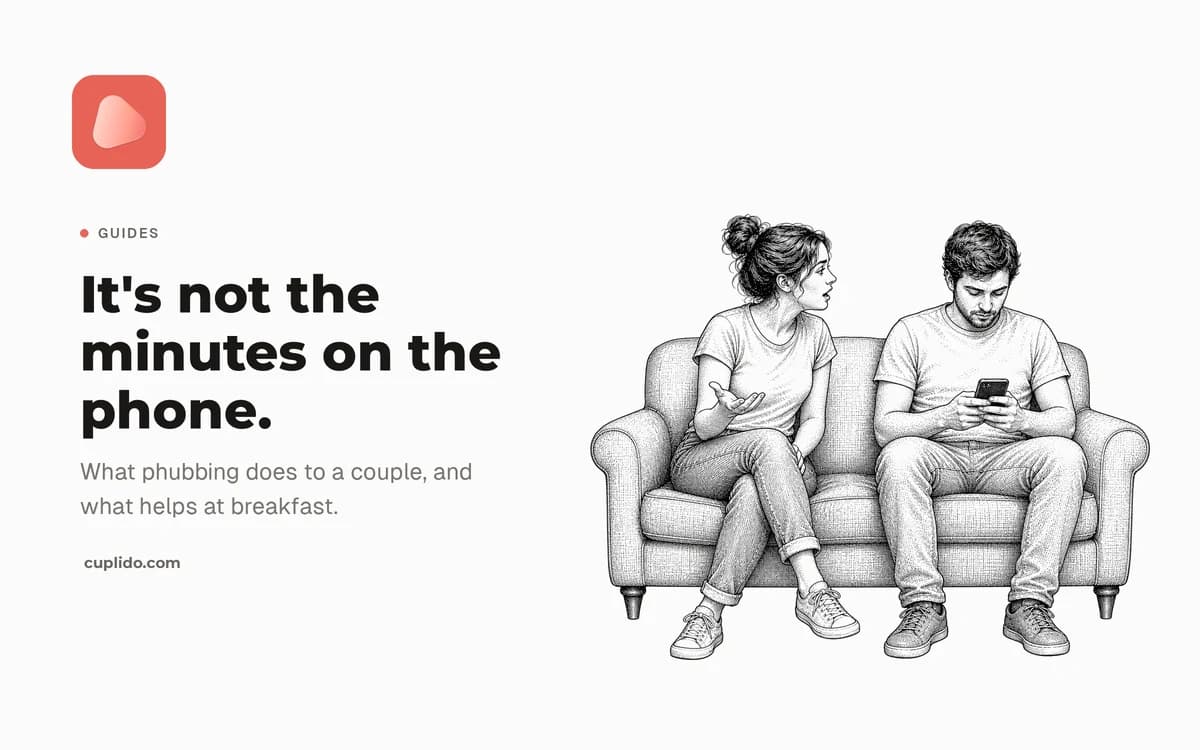
You are telling them about the thing that happened at work. They say "mm". Their thumb is still moving. You stop in the middle of the sentence to see if they notice, and they do not.
Nobody did anything terrible. But you have just learned where you rank against a group chat, and you will remember it at dinner.
There is a word for this: phubbing, short for phone snubbing. It means picking up your phone, or staying on it, while someone is talking to you. If you are here because your partner is always on their phone, the research on phubbing has one finding that changes what you should do about it.
What phubbing does to a couple
The first studies asked people how often their partner did specific things: kept the phone in their hand when you were together, glanced at it in the middle of a conversation, checked it when the talk went quiet.
A lot of people said their partner did these things. The ones who said it also reported more arguments about the phone, and those arguments were linked to feeling less happy in the relationship. So the phone does not cool things directly. It starts a particular fight, the one that begins "you are always on that thing", and that fight does the damage.
The surprise: the minutes are not what hurts
A later diary study followed couples day by day. Each partner reported two things: how much they felt phubbed that day, and how much they had used their own phone around the other one.
On the days people felt phubbed, they rated their relationship lower. That part was expected. The surprise was the second measure. How much the partner said they had used the phone made no difference to how the relationship was rated.
Read that again as a couple. The feeling of being ignored predicted a bad day. The amount of phone use did not.
Why a screen time limit will not fix it
This is why the usual fix fails. You agree on a limit, one of you goes from three hours a day to two, and nothing feels different. The hour you saved came out of the bus ride and the queue at the supermarket, where nobody was being ignored in the first place.
What your partner notices is not a total. They notice the one time they were in the middle of a sentence and lost you. One of those at dinner outweighs an hour of scrolling on the train.
So the useful question is not "how long are you on it?". It is "when are we obviously not on it?".
What helps: moments where the phone is clearly somewhere else
You do not need a phone-free life. You need two or three moments in a normal week where both of you can see that the phone is not in the room. Face down on the table does not count. It still buzzes, and you both know it is there.
Breakfast. Tonight, leave both phones charging in the bedroom, not the kitchen. Whoever is up second makes the coffee. Eat with nothing glowing on the table and start on something that is not the day ahead: the dream you had, what you read last night, the person you keep meaning to text. Whoever goes back to the bedroom for a phone makes breakfast again tomorrow.
Dinner. Use restaurant rules at your own table: both phones in another room, and each of you brings one thing to talk about that has nothing to do with the house.
The first ten minutes at home. Whoever gets in second gets ten minutes of the other one's full attention before anybody looks at a screen. Coat off, sit down, "who annoyed you today?".
Pick one. Do it for a week before you add another. If phone-free evenings are a new idea in your house, breakfast is the easy one, because nobody has much to check at seven in the morning.
How to bring it up without starting the phone fight
The research says the argument about the phone is the route to the damage, so how you raise it matters.
Say what you miss, not what they do wrong. "I miss talking to you at dinner" is an invitation. "You are always on your phone" is a charge, and the answer to a charge is a defence: "so are you".
Make it a rule for both of you. One person policing the other person's screen is a parent and a teenager. Two phones in the bedroom at breakfast is a deal between two adults.
And expect to be the one who breaks it. Most people who feel phubbed also do it. The diary study measured both partners for a reason.
When there is nothing to do once the phones are down
Here is the part couples skip. You put both phones in another room, you sit down, and there is a silence, because the phone was filling a gap and now the gap is in the room with you.
That silence is not a sign that something is wrong with the two of you. It means the time together had nothing in the middle of it. A question fixes it. So does a plan.
This is the gap Cuplido was built for. You tell it two things once: what you both miss, and when you are usually free. Early in the week you already know which afternoon or evening is yours, and a day or two before you find out what you are doing. On your other free days there is a small thing to do together and a question to answer, so the phone has something to lose to.
If the quiet has gone on for longer than one busy month explains, start with feeling like roommates. If you have the hours and they keep disappearing, read quality time for couples.
Common questions
What is phubbing? Phubbing is phone snubbing: picking up your phone, or staying on it, while someone is talking to you. Partner phubbing is the same thing between two people in a relationship. It covers the glance at a notification in the middle of a sentence as well as the full scroll through dinner.
Does phubbing really damage a relationship? The research says yes, through one route. People who feel phubbed by their partner argue about the phone more, and those arguments are linked to lower satisfaction with the relationship. In a diary study, people rated their relationship lower on the days they felt phubbed, whatever their partner said about their own phone use that day.
What should I do if my partner is always on their phone? Do not start with a screen time limit. Pick one or two moments in the day where both phones are in another room, such as breakfast or dinner, and agree on them together. Say what you miss, not what they do wrong: 'I miss talking to you at dinner' gets a different answer from 'you are always on that thing'.
Is it normal for couples to be on their phones in the evening? Yes. Two people on a sofa with two phones is how most evenings go, and it is company, which is worth having. It becomes a problem when it is the only kind of time you have together, or when one of you is talking and the other one is still scrolling.
Tonight, both phones charge in the bedroom. Start with breakfast.
Sources
- Roberts & David (2016), My life has become a major distraction from my cell phone: Partner phubbing and relationship satisfaction among romantic partners, Computers in Human Behavior. https://kellercenter.hankamer.baylor.edu/news/story/2017/partner-phubbing-how-cell-phones-impact-romantic-partnerships
- Carnelley, Vowels, Stanton, Millings & Hart (2023), Perceived partner phubbing predicts lower relationship quality but partners' enacted phubbing does not, Computers in Human Behavior. https://www.research.ed.ac.uk/en/publications/perceived-partner-phubbing-predicts-lower-relationship-quality-bu
Pick what you miss. Get it back.
Tell Cuplido what you miss and when you're free. A real plan with a day and a time, small moments on your other free days, and a question a day. No list to browse, no prompt to write.
Questions before you download? Check the couples app FAQ or browse couples rituals on the blog.